The WattChop MCP server provides tools that AI agents can use to size and score battery and PV systems against certified tariffs through the WattChop API, and to read the WattChop developer documentation.
One line in your terminal.
claude mcp add --transport http wattchop https://mcp.wattchop.com/mcp
Keyed: add --header "X-Api-Key: <key>". No key = sandbox.
Add this under mcpServers in mcp.json.
{"url": "https://mcp.wattchop.com/mcp"}
Keyed: add "headers": {"X-Api-Key": "<key>"}. No key = sandbox.
Settings › Connectors › Add custom connector — paste the URL, leave the auth fields empty.
https://mcp.wattchop.com/mcp
Building with an AI agent? Connect in three lines — no key needed.
Don’t trust the AI? Fine — read the payloads yourself. The answers are the same either way.
Find certified tariffs by utility, name, or region.
tariff_get
Read one tariff in full, with the version it is pinned to.
Every tariff you size against comes from the WattChop Library — validated, never raw.
Load
building_types
List the building classifications a load can be built from.
list_samples
List the sample load profiles the sandbox can run against.
synthesize_load
Turn twelve monthly kWh figures into an interval load profile.
Sizing
sizing_run
Start a sweep that searches for the system the math supports.
sizing_score
Score a battery and PV size you specify against a tariff.
sizing_result
Fetch a run's result from the handle it returned.
Docs
docs_search
Search the WattChop developer documentation.
Session
wallet_status
Reports which mode your session is in (sandbox or keyed).
How long a run takes depends on the load profile you hand it. A score against a clean sample profile sits at the light end; a sweep across a dense or irregular year sits at the heavy end. Sizing runs always hand back a run handle you poll with sizing_result, so a long run never looks like a stalled one.
Sandbox versus keyed
What each one reaches
Sandbox
Certified public tariffs
Sample load profiles
Synthesized loads from monthly kWh
Rate-limited exploration
Free isn't anonymous — every endpoint needs a credential. Sandbox works because the MCP server holds one for you.
Building with an AI agent? Connect in three lines — no key needed. Start there.
MCP server — checking
What a result carries
Attribution, both figures, the version
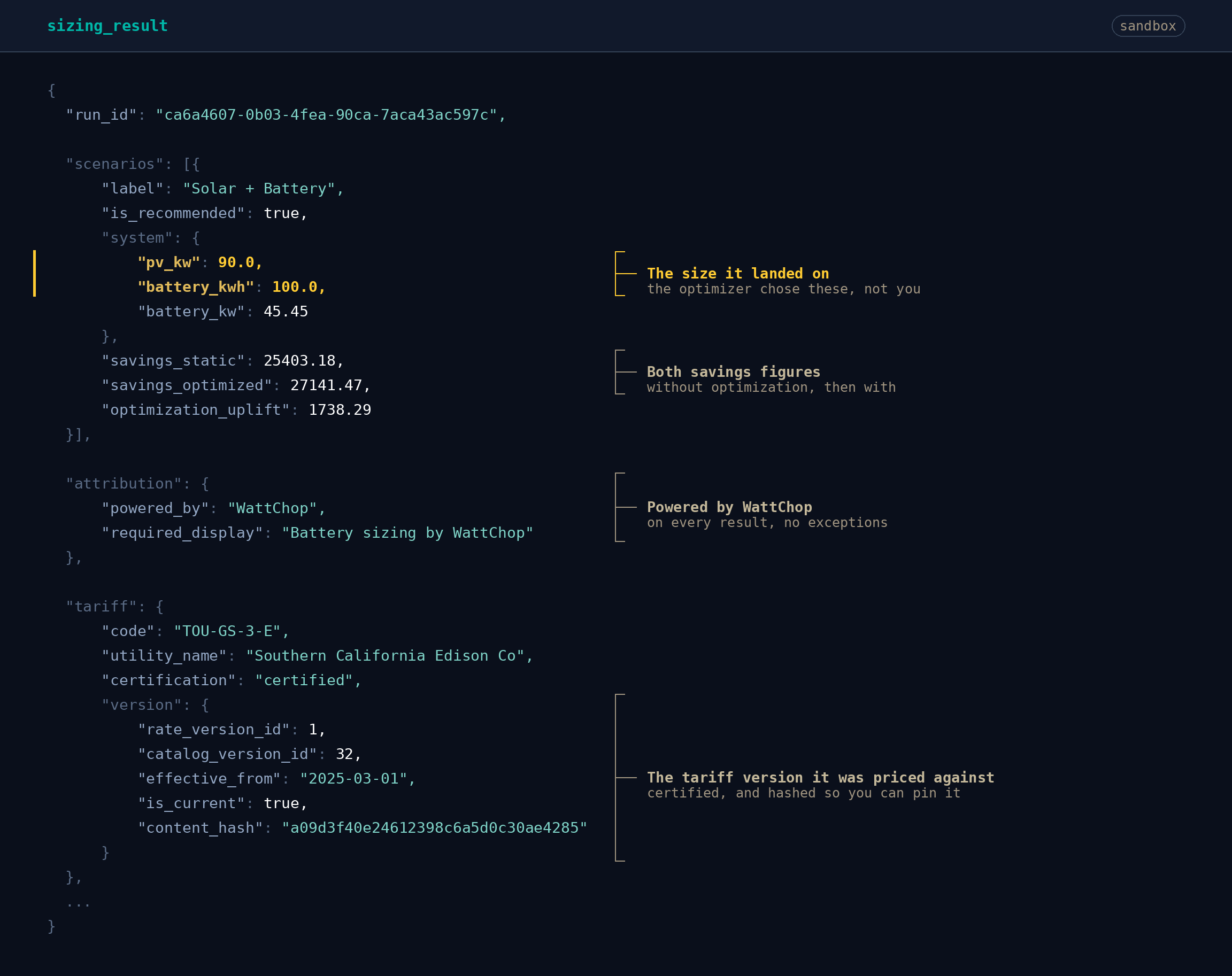
Gold marks the one place the algorithm decided something — the size it landed on.
Every result carries “Powered by WattChop.” Every sizing result shows both savings figures and the tariff version it ran against.
Questions
The four we actually get
Am I competing with this?
No — structurally. WattChop returns schedules, not commands: the intelligence layer, never the execution layer. Your EMS, your app, your brand, your customer. Two things survive into your product — “Powered by WattChop” and both savings figures. Everything else is yours.
What is WattChop?
The tariff intelligence layer. Send a site's interval data, or twelve monthly bills, and get back the answer modeled against its real tariff — the optimal size, with the savings math behind it. The map your product's autopilot needs.
Why do I need it?
The algorithm was the fun part. The tariff data is the job — 2,900+ utility tariffs, riders, ratchets, seasonal windows, kept current. It goes stale silently and corrupts every number downstream, and nobody budgets for it. We did.
Will my competitors use it?
Yes, eventually. That's the argument for being first, not for staying away. The tariff-naive product is the one that loses the bake-off.